How To True A Heavy Ebike Wheel Setup Manual
Mastering heavy electric bicycle wheel alignment requires specialized spoke tensioning techniques and robust workshop tools. This manual covers safe truing procedures for high-torque rims.

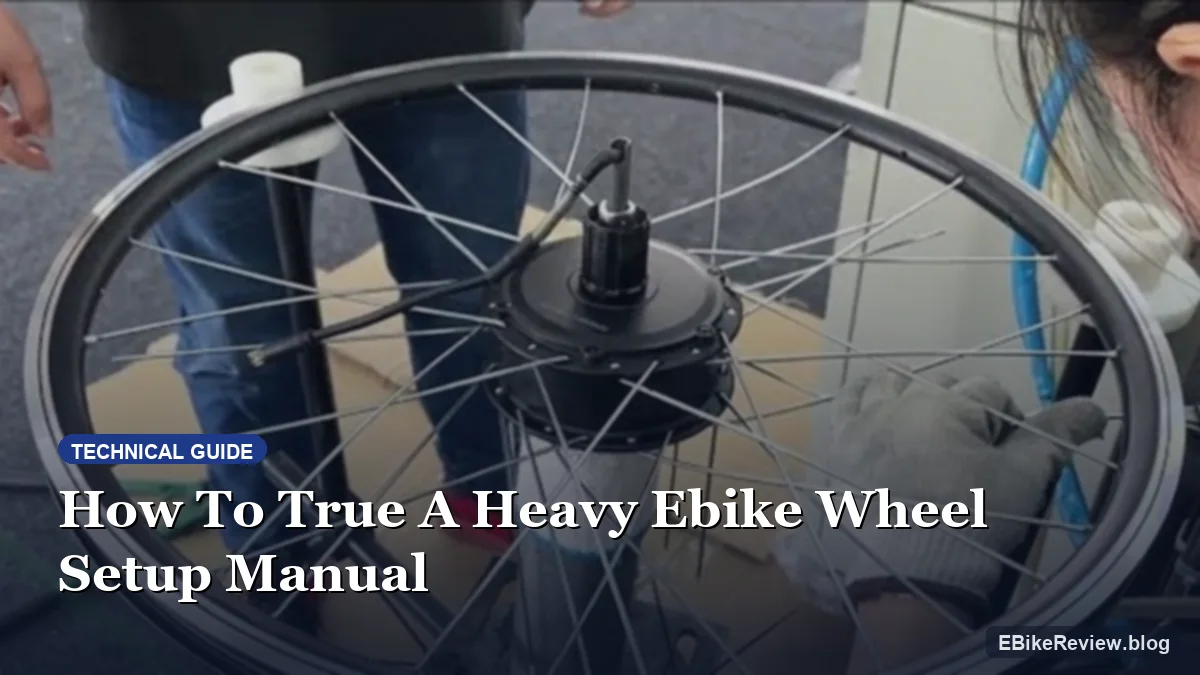
True heavy ebike wheels by systematically balancing spoke tension across the entire rim using a robust truing stand and a dedicated tension meter. Always adjust in quarter-turn increments to prevent rim damage.
Looking for matching picks? See our Best Electric Bike For Heavy Riders: Top 2026 Picks.
Practical Quick-Reference Table
| Scenario / Metric | Recommended Target | Why It Matters |
|---|---|---|
| Lateral Truing Tolerance | Plus or minus 0.5 millimeters | Prevents brake rub and erratic steering response. |
| Radial Truing Tolerance | Plus or minus 0.75 millimeters | Eliminates vertical bouncing at high speeds. |
| Spoke Gauge Standard | 12-gauge or 13-gauge thick wire | Handles massive rear hub motor torque safely. |
| Tension Variance Limit | Within 10 percent average | Ensures even load distribution across the rim. |
| Nipple Engagement Key | Precision 4-sided spoke wrench | Prevents rounding off soft brass spoke nipples. |
| Max Truing Adjustment | One-quarter turn per session | Avoids sudden stress spikes in the wheel build. |
Core Fundamentals of Heavy Ebike Wheels
Heavy electric bicycles subject their wheel assemblies to extreme rotational stresses, high motor torque, and significant payload weight. Understanding rim dynamics is essential before attempting any physical alignment work on your machine.
Rear wheels on models built like the best ebike for heavy guys require distinct handling. The massive motor shell creates asymmetric bracing angles that demand precise spoke tensioning strategies.
Rim extrusion profiles on cargo and commuter platforms feature thicker walls and eyeleted spoke holes. These reinforced designs resist cracking under high tension but require specialized tools for successful truing operations.
Fat tire ebike wheels introduce high-volume casings that obscure minor truing errors during visual inspections. Technicians must rely strictly on mechanical dial indicators rather than relying solely on tire clearance checks.
- Heavy hub motors create asymmetric bracing angles requiring custom tension balancing.
- Reinforced rim extrusions demand high-quality steel spoke wrenches to prevent slip.
- Fat tire air volume masks small wobbles, necessitating direct rim gauge measurements.
- Payload weight accelerates fatigue, making regular tension checks mandatory for safety.
Anatomy of Motor-Driven Wheel Assemblies
Direct-drive motors occupy substantial hub space, drastically shortening the effective length of the spokes on that specific side. This geometric constraint creates high tension disparities between drive and non-drive flanges.
Gearing hub motors offer slightly better flange spacing, yet they still experience heavy rotational forces under rapid acceleration. Mechanics must account for these mechanical realities during every adjustment phase.
- Shortened spoke lengths increase sensitivity to tiny nipple adjustments.
- Flange spacing differences dictate unequal baseline tension requirements.
Workshop Tools and Stand Calibration
Securing your heavy utility machine or best commuter ebike wheel in a professional-grade truing stand is the foundation of accurate alignment. Standard bicycle stands often flex under massive motorized weight.
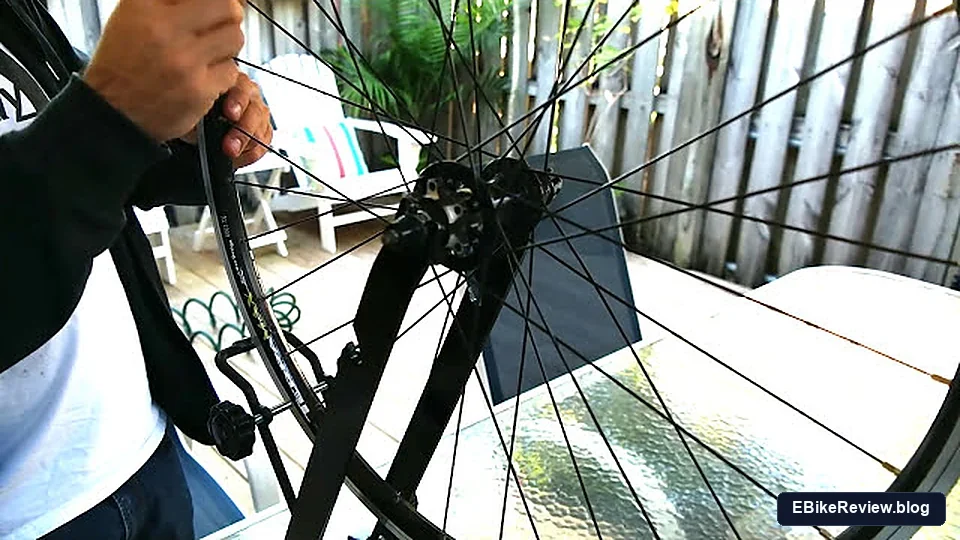
Calibrate your truing stand by centering the internal feeler calipers against a known true reference wheel. Skipping this calibration step introduces systematic errors that worsen lateral wobble during the repair process.
Select a high-tolerance spoke wrench that engages four flat sides of the nipple securely. Cheap tools slip easily under the high torque required for thick 12-gauge ebike spokes, ruining the hardware.
Keep a professional dial indicator mounted firmly to the stand frame for precise measurement readings. Visual checks alone cannot capture the micro-deviations common in heavy utility electric bicycle rims.
- Use rigid steel stands capable of supporting heavy motorized wheel assemblies securely.
- Verify caliper alignment against a known reference rim prior to starting work.
- Select professional four-sided spoke wrenches matching your exact nipple dimensions.
- Mount dial indicators for precise numerical tracking of lateral and radial runout.
Preparing the Wheel for Mounting
Remove the heavy tire, tube, and brake rotor to eliminate balancing interference and weight sag. Stripping the rim down allows the truing stand calipers to read the bare metal surface accurately.
Inspect all spoke threads for corrosion or binding before mounting the wheel into the stand. Apply a single drop of light penetrating oil to stubborn nipples to ease tension adjustments.
- Strip tires, tubes, and rotors for unobstructed metal surface measurement.
- Lubricate stubborn nipple threads with light oil to ensure smooth turning.
Video Walkthrough: How to true an electric bicycle hubmotor
Spoke Tension Meter Diagnostics
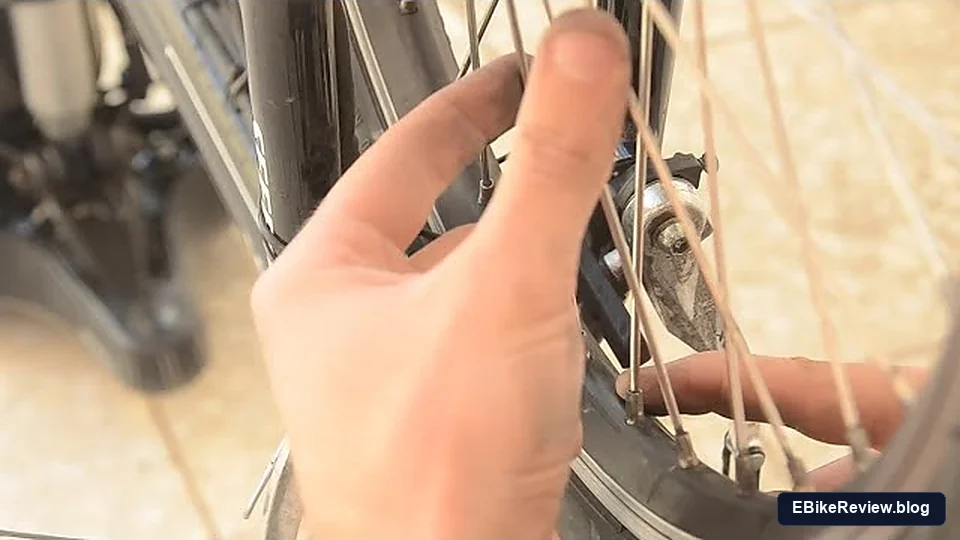
Measuring individual spoke tension with a calibrated mechanical tool prevents structural failure across the wheel build. Uneven tension remains the primary cause of broken spokes on heavy electric commuter bikes.
Consult the conversion chart provided with your tension meter to translate deflection readings into exact kilograms of force. Thick spokes found on the best hunting ebike require specific calibration tables for assessment.
Map out all spoke tensions on a workshop notepad before making any physical adjustments on the rim. Identify loose zones and overly tight clusters to establish a clear correction roadmap.
Strive for uniform tension across all spokes on the same side of the wheel hub flange. Minor variances are acceptable, but major outliers will eventually fatigue and snap under heavy loads.
- Use a calibrated tension meter to record baseline values across every spoke.
- Consult manufacturer conversion charts for thick 12-gauge and 13-gauge wires.
- Map tension variations on paper before turning any individual spoke nipples.
- Maintain uniform tension within ten percent across identical flange groupings.
Interpreting Tension Deflection Data
High deflection readings indicate loose spokes that require tightening to restore structural integrity. Conversely, extremely low deflection numbers signal high tension zones that need immediate relief.
Record your post-adjustment measurements to verify that the overall wheel tension remains balanced. Systematic documentation guarantees long-term durability under heavy everyday riding conditions.
- Translate spring deflection numbers into exact kilogram-force units.
- Log post-adjustment data to ensure balanced final wheel rigidity.
Addressing Lateral Wobble and Side-to-Side Alignment
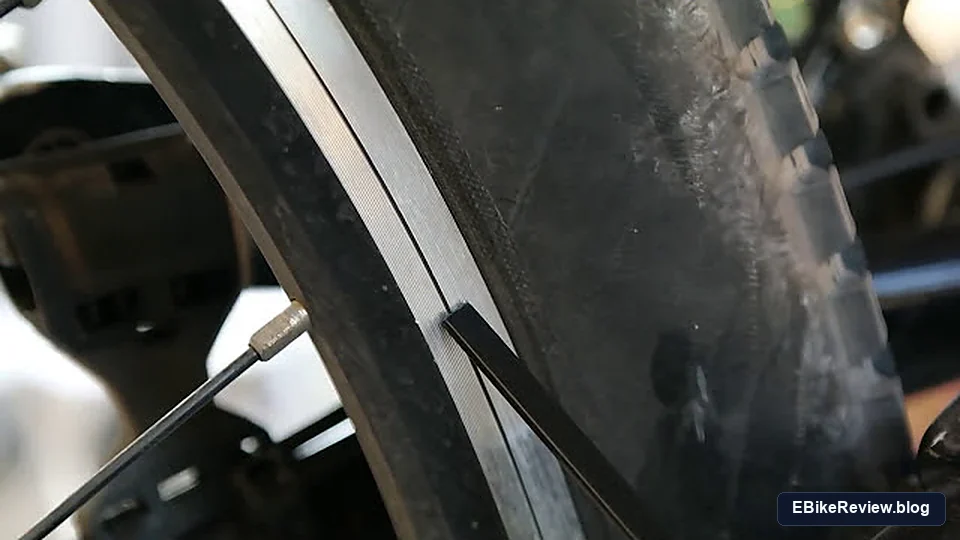
Spin the wheel slowly in the truing stand to locate the exact boundaries of any lateral wobble. Adjust the feeler calipers inward until they gently brush against the widest section of the rim.
Identify the specific group of spokes pulling the rim toward the rubbing caliper side. To pull the rim away, tighten the opposing spokes by no more than one-quarter turn.
Complementary adjustments are vital when correcting lateral errors on heavy motorized wheel assemblies. Loosen the adjacent spokes on the opposite flange by an equivalent amount to maintain stable overall tension.
Work methodically around the entire circumference of the wheel rather than over-correcting a single spot. Patience during this phase prevents creating new radial lumps or severe structural imbalances.
- Locate lateral wobble peaks using fine-tuned stand caliper feelers.
- Tighten opposing spokes in quarter-turn increments to pull the rim straight.
- Loosen adjacent side spokes slightly to preserve overall wheel tension balance.
- Proceed methodically around the entire rim circumference without rushing.
Executing Precise Lateral Corrections
Focus on correcting the widest wobble zones first before addressing minor alignment deviations. Small imperfections often resolve naturally once major structural lateral bends are corrected.
Re-check your progress frequently by spinning the heavy wheel at moderate speeds in the stand. Ensure the calipers maintain a consistent clearance gap throughout the entire rotation.
- Prioritize wide wobble zones before chasing minor rim imperfections.
- Spin the wheel frequently to verify consistent caliper clearance gaps.
Correcting Vertical Hop and Radial Out-of-Round
Radial runout refers to vertical hops where the rim moves closer to or farther from the hub center. This condition creates an uncomfortable bouncing sensation during high-speed electric bicycle descents.
Position your truing stand indicator to monitor the outer circumference of the rim bed. Identify high spots where the rim pushes outward away from the center axle axis.
To pull a radial high spot inward, tighten all spokes in that localized area equally. Make incremental turns of one-eighth to one-quarter turn to distribute the pulling force evenly.
Address radial low spots by loosening the local spokes while simultaneously tightening surrounding structural wires. Balancing radial and lateral adjustments simultaneously requires immense technical discipline and steady hands.
- Monitor vertical rim movement using a dedicated radial indicator probe.
- Tighten localized groups of spokes equally to pull down radial high spots.
- Adjust tension in tiny fractions to protect the overall rim structural integrity.
- Balance radial and lateral corrections concurrently to avoid compounding errors.
Managing Stubborn Radial Flat Spots
Severe impacts from potholes can create permanent flat spots in heavy rims, which drastically reduce efficiency. Before consulting an ebike range calculator, technicians must true the wheel to eliminate parasitic friction.
Inspect the rim sidewall closely for hairline cracks whenever executing major radial adjustments. Damaged aluminum extrusions must be replaced immediately for rider safety.
- Address impact flat spots by releasing tension around the damaged zone.
- Inspect metal sidewalls for stress cracks during major radial pulls.
Video Walkthrough: Phantom Wallet
Managing Heavy Hub Motor Wheel Specifics
Direct-drive hub motors create heavy rotational inertia that strains the entire wheel laced assembly. Specialized lacing patterns, such as cross-three or cross-four, are standard for distributing this intense motor torque.
Spoke breakage typically initiates near the J-bend flange due to constant acceleration fatigue. Inspect these critical bend radiuses under bright workshop lighting during every routine truing session.
Tightening spokes on a motorized wheel requires reaching past the bulky central hub shell. Use specialized offset spoke wrenches to maintain proper tool engagement without damaging the motor cables.
Never allow spoke wrenches to twist or scrape against delicate phase wires emerging from the axle. Secure all internal wiring safely out of the working zone before beginning adjustments.
- Respect cross-three and cross-four lacing patterns designed for high motor torque.
- Inspect spoke J-bends closely for fatigue cracks during routine maintenance.
- Utilize offset spoke wrenches to clear bulky hub shells safely.
- Protect electrical phase wires from accidental tool strikes during adjustments.
Handling Asymmetric Bracing Angles
Asymmetric spoke bracing creates uneven tension loads between the left and right wheel flanges. Compensate for this geometry by verifying tension meter readings against specific manufacturer guidelines.
Maintain high baseline tension on the lower-bracing side to prevent premature fatigue failure. Balanced foundational tension keeps heavy motorized wheels rolling smoothly for years.
- Account for unequal bracing geometry using specialized tension meters.
- Keep baseline tension high on weaker flanges to prevent fatigue snaps.
Common Mistakes and Troubleshooting Guide
Over-tightening spokes in a desperate attempt to fix a wobble ruins rim structural integrity. Always relieve opposing tension rather than continuously cranking down on a single troublesome area.
Failing to destress the wheel after making major adjustments leads to immediate post-ride alignment failure. Heavy ebike wheels settle aggressively during their first test ride under load.
Ignoring wind-up in thick ebike spokes causes hidden torsional stress that snaps wires prematurely. Counteract wind-up by backing off one-quarter turn after every major tightening sequence.
Using incorrect wrench sizes rounds off brass spoke nipples, making future adjustments nearly impossible. Invest in precision-machined tools to protect your hardware investment during every workshop session.
- Avoid over-tightening single spokes to fix complex rim wobbles.
- Always stress-relieve the wheel by manual compression before final testing.
- Counteract spoke wind-up to eliminate hidden torsional internal stress.
- Use exact-fit wrenches to prevent stripping soft brass spoke nipples.
Executing Proper Wheel Stress Relief
Stress-relieving involves firmly squeezing parallel pairs of spokes together by hand. You will hear dull clicking sounds as the spokes settle naturally into the hub flange seats.
Repeat the truing process after stress relief to catch any newly developed wobbles. This essential step guarantees your alignment will hold up under harsh road conditions.
- Squeeze parallel spoke pairs firmly by hand to settle flange seating.
- Recheck truing stand alignment after stress relief to ensure stability.
Maintenance and Safety Protocols
Establish a regular inspection schedule for your heavy ebike wheels based on riding mileage. Routine checks catch loose spokes long before they develop into dangerous structural failures.
Clean grime and brake dust from the rim surface before mounting it in your truing stand. Debris on the sidewall interferes with caliper feelers and compromises measurement accuracy.
Verify axle nut torque and frame dropout alignment alongside your wheel truing maintenance. A properly trued wheel cannot compensate for a crooked axle or damaged frame interface.
Perform a careful road test at low speeds immediately following any major wheel alignment. Listen closely for any pinging noises that indicate settling spokes requiring minor follow-up tweaks.
- Inspect heavy wheels according to strict mileage-based maintenance intervals.
- Clean rim sidewalls thoroughly to ensure precise caliper measurements.
- Check axle nut torque and frame dropout alignment alongside truing work.
- Execute low-speed test rides to verify settling and final alignment stability.
Long-Term Durability Best Practices
Apply a tiny drop of lightweight thread locker to nipple threads during major wheel rebuilds. This prevents vibration from backing off tension during rough utility rides.
Store your electric bicycle with balanced tire pressures to minimize localized rim stress. Proper storage habits protect your investment and extend overall wheel lifespan.
- Apply light thread locker to nipple threads during complete rebuilds.
- Maintain proper tire pressure storage to reduce localized rim loading.
Frequently Asked Questions
How often should I true my heavy ebike wheel?
Inspect your heavy ebike wheels every thousand miles of riding. High-torque hub motors accelerate spoke loosening, requiring proactive maintenance.
Can I true a motorized wheel with the tire installed?
Removing the tire and tube is strongly recommended for precise measurements. Tires often hide minor lateral wobbles and radial lumps.
What causes spokes to snap on heavy electric bikes?
Uneven spoke tension and heavy payload stress cause fatigue cracks. Using a tension meter prevents these structural failures.
Why do my spoke nipples keep rounding off?
Cheap wrenches or incorrect sizing causes nipple damage. Always use a precision four-sided wrench for thick ebike wires.
How do I fix spoke wind-up during truing?
Counteract torsional twist by backing off one-quarter turn after tightening. This eliminates hidden stress inside the spoke wire.