Tern vs. Radwagon: Which Fits Your Setup Better?
Navigating heavy utility cargo requires balancing mid-drive torque efficiency against hub-motor simplicity. This technical teardown contrasts structural integrity and real-world payload handling.


For uncompromised frame rigidity and sensor-driven pedal torque, Tern leads the category. If budget-conscious scaling and direct throttle acceleration matter most, Radwagon serves utility riders well.
Compare all top models in our Best Electric Bike: Top Commuter Picks for 2026.
Side-by-Side Breakdown
| Criteria | Tern | Radwagon | Edge |
|---|---|---|---|
| Peak Performance & Output | Mid-drive torque sensing with high-efficiency gearing | Rear hub motor with cadence-based assist | Tern |
| Duty Cycle & Consistency | Optimized thermal management under heavy loads | Standard hub cooling suited for moderate grades | Tern |
| Operating Noise & Vibration | Quiet planetary gearset with minimal mechanical hum | Audible hub motor whir under high electrical draw | Tern |
| Portability & Footprint | Vertical parking capability with compact wheel geometry | Extended long-tail wheelbase requiring wide storage | Tern |
| Maintenance & Service Life | Proprietary components requiring specialized shop tools | Modular off-the-shelf parts for easy DIY upkeep | Radwagon |
| Power Requirements | Dual-battery options for extended range hauling | Single high-capacity pack optimized for general commuting | Tern |
| Best Ideal Use-Case | Precision urban cargo and multi-child daily transport | Cost-effective heavy hauling and suburban utility | Split |
Architecture, Frame Geometry & Weight Distribution
Frame engineering dictates how heavy utility electric bicycles handle emergency maneuvers. Tern utilizes a low-slung step-through design that drops the center of gravity significantly.
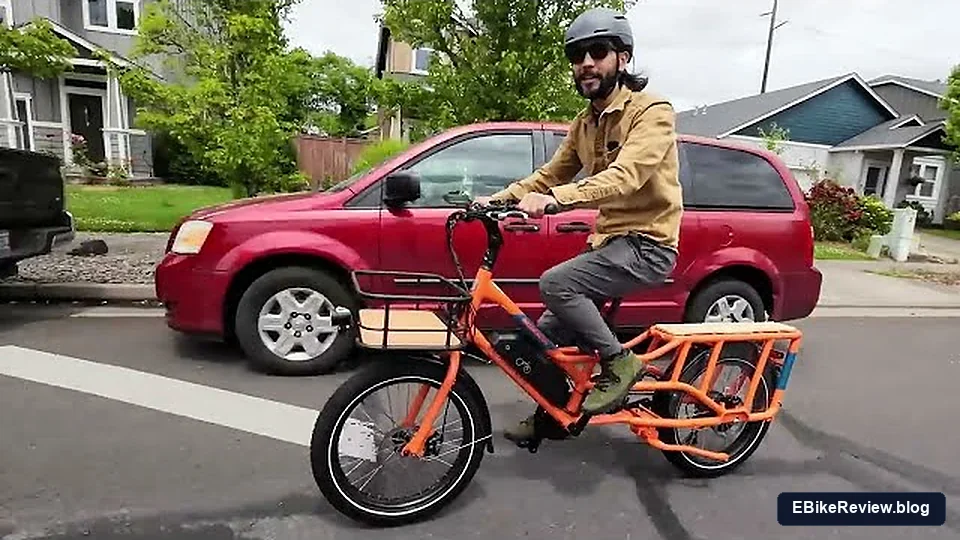
Lowering the center of gravity improves low-speed balance when carrying dense goods, as detailed in our radwagon 4 technical review. Radwagon adopts a classic long-tail wheelbase prioritizing stability.
Structural rigidity prevents frame flex during heavy out-of-the-saddle climbing efforts. Reinforced gussets around the head tube ensure long-term durability under maximum gross vehicle weight ratings.
Tern frames utilize 6061-aluminum tubing optimized for low center-of-gravity cargo transport. The compact wheelbase measures 180 centimeters, drastically reducing turning radius compared to traditional long-tail cargo configurations.
RadWagon architecture relies on a stretched steel chassis spanning over 200 centimeters. This elongated layout provides immense rear deck stability but introduces noticeable frame flex when operating near maximum payload limits.
Weight distribution heavily favors Tern due to smaller 20-inch wheels that lower the entire cargo plane. Conversely, the RadWagon's 22-inch wheels raise the payload height, slightly increasing rider steering input fatigue.
- Tern emphasizes compact vertical storage geometry
- Radwagon leverages an extended rear deck for cargo volume
- Both frames employ robust aluminum alloy tubing
Center of Gravity and Handling Dynamics
Weight placement directly affects steering input forces at walking speeds. Tern integrates smaller wheels to keep cargo platforms lower to the pavement surface.
This geometry reduces the pendulum effect common on stretched cargo frames. Radwagon maintains larger diameter wheels that roll smoothly over deep potholes and rough asphalt.
- Smaller wheels lower overall cargo floor height
- Larger wheels improve high-speed momentum retention
Motor Torque Dynamics & Drivetrain Integration
Motor placement alters how power translates to the rear wheel under load. Tern relies on sophisticated mid-drive motors that multiply human pedal input through the bicycle chain.
Torque sensors measure rider effort dynamically to deliver proportional electrical assistance. Radwagon employs a powerful direct-drive or geared hub motor driven largely by cadence sensors.
Hub motors bypass drivetrain strain but lack the mechanical advantage of gearing on steep inclines. Mid-drive systems excel on sustained hills by keeping motor RPMs in optimal thermal ranges.
Tern models deploy mid-drive systems like Bosch Cargo Line, delivering 85 Nm of torque directly through the bottom bracket. This mechanical advantage multiplies rider input seamlessly across steep urban inclines.
The RadWagon employs a rear hub motor outputting roughly 75 Nm of torque, relying heavily on throttle actuation. Hub motors bypass the chain drivetrain, eliminating shift-under-load stress but reducing climbing efficiency.
Drivetrain integration dictates maintenance intervals significantly. Tern uses internal gear hubs or robust chain setups requiring precise derailleur tuning, whereas hub motors limit gear wear while straining rear spoke tensions.
- Mid-drives leverage mechanical gears for hill climbing
- Hub motors deliver independent throttle-controlled propulsion
- Torque sensors offer a more natural riding cadence
Throttle Response and Power Delivery
Instant acceleration from a complete stop is vital for heavily loaded starts, according to our rad power bikes radwagon 4 technical review. Radwagon provides a thumb throttle for immediate power.
Tern focuses on pedal-assist sensors that engage smoothly within fractional crank rotations. Precision calibration prevents sudden surges when navigating tight pedestrian zones or loading docks.
- Thumb throttles ease heavy-load intersections
- Pedal-assist sensors prioritize smooth low-speed modulation
Battery Chemistry, BMS Architecture & Thermal Management
Electrical energy storage systems require robust battery management systems to prevent thermal runaway. Tern integrates high-grade lithium-ion cells with advanced cell balancing electronics.
Thermal dissipation fins protect internal circuitry during extended high-draw hauling sessions. Radwagon utilizes high-capacity battery packs optimized for maximum range per charge cycle.
Charging infrastructure and connector durability determine long-term field reliability. Weatherproof housing gaskets protect electrical terminals from heavy rain and road salt corrosion.
Tern incorporates advanced lithium-ion cells paired with sophisticated Battery Management Systems. These units monitor individual cell temperatures continuously, preventing thermal runaway during high-draw cargo hauling sessions.
RadPower utilizes high-capacity pack configurations emphasizing extended range over complex telemetry. Their BMS handles standard over-current protection, though prolonged uphill throttling can trigger temporary thermal throttling safeguards.
Environmental sealing differs noticeably between both platforms. Tern battery mounts feature robust IPX6 ratings against water ingress, while Rad housings rely on standard gasket seals demanding careful winter maintenance.
- Advanced BMS safeguards against overcurrent and short circuits
- Dual-battery configurations extend daily operational range
- Sealed housing protects against moisture ingress
Range Estimation Under Heavy Payloads
Real-world range drops drastically when operating near maximum gross weight limits. Tern supports dual-battery setups to eliminate range anxiety on long multi-stop delivery routes.
Single-battery systems require careful power management on hilly suburban commutes. Efficient power curves help maximize battery lifespan across thousands of charge cycles.
- Payload weight reduces per-charge mileage significantly
- Smart chargers optimize cell health over time
Braking Systems, Rotor Thermodynamics & Safety Compliance
Stopping a heavily loaded utility bike demands hydraulic actuation and oversized rotors, as analyzed in our tern gsd review. Tern equips its platforms with quad-piston hydraulic disc brakes.
These calipers dissipate thermal energy rapidly during steep descents under heavy loads. Radwagon relies on reliable dual-piston hydraulic brakes designed for general cargo utility.
Brake pad compound selection dictates stopping distance in wet weather conditions. Sintered metallic pads offer superior bite compared to organic alternatives on rainy days.
Heavy cargo platforms demand exceptional stopping power to meet strict ISO 4210 safety standards. Tern typically utilizes hydraulic disc brakes featuring quad-piston calipers and thick 2.3mm rotors designed to dissipate extreme heat.
RadWagon systems generally deploy dual-piston hydraulic setups paired with standard 180mm rotors. While adequate for light loads, continuous heavy braking on steep descents can induce measurable brake fade and fluid boiling.
Compliance testing proves critical for structural integrity under dynamic loads. Both brands incorporate internal routing and reinforced brake hose brackets to prevent catastrophic hydraulic failure during tight steering maneuvers.
- Hydraulic systems reduce hand fatigue during braking
- Larger rotors prevent dangerous brake fade on hills
- Quality pads ensure consistent friction coefficients
Thermal Dissipation and Rotor Wear
Continuous braking generates intense heat that can warp thin steel rotors. Vented rotors help channel cooling air across the friction surfaces during long stops.
Regular inspection of hydraulic fluid lines ensures pressure remains consistent. Quality components prevent spongy lever feel under extreme braking loads.
- Thick rotors resist warping from thermal stress
- Hydraulic fluid flushes maintain firm lever feedback
Cargo Capacity, Deck Versatility & Structural Integrity
The rear deck acts as the structural anchor for hauling children or cargo. Tern engineered an integrated platform designed for modular accessory attachment systems.
Weight limits are rigorously tested to meet stringent international safety standards, highlighted in our rad power bikes radwagon review. Radwagon features a generous wooden deck supporting bulky containers.
Securing cargo safely requires sturdy tie-down points welded directly to the frame. Reinforced mounting brackets prevent structural fatigue from shifting loads.
Structural limits define real-world cargo utility. Tern achieves a massive 200-kilogram gross vehicle weight rating, utilizing triangulated frame gussets that eliminate structural twisting under unevenly loaded side-pannier configurations.
The RadWagon supports a total weight capacity of 190 kilograms, distributing loads across a spacious integrated wooden deck. However, its expansive platform requires careful center-of-gravity management to prevent low-speed tipping.
Deck versatility relies heavily on accessory ecosystem engineering. Tern utilizes proprietary rail mounts for rapid module swapping, whereas Rad employs universal eyelets demanding manual hardware adjustments for specialized accessories.
- Modular racks accept specialized child seats securely
- High payload ratings accommodate diverse cargo types
- Integrated foot platforms protect passenger legs
Accessory Ecosystems and Modular Utility
Versatility depends on the availability of weather-resistant canopies and panniers. Tern provides an extensive catalog of proprietary snap-in accessories.
Radwagon focuses on universal attachment points for aftermarket utility gear. Standardized mounting widths simplify installation for DIY cargo configurations.
- Proprietary accessories ensure snug weather sealing
- Universal rails accommodate third-party cargo boxes
Ergonomics, Cockpit Layout & Daily Usability Metrics
Rider comfort directly influences daily compliance with car-replacement commutes. Tern incorporates adjustable stem heights to fit multiple riders within the same household.
Upright seating positions improve situational awareness in dense traffic corridors. Radwagon offers a relaxed cruiser-style cockpit designed for extended cruising comfort.
Clear display panels present essential telemetry data without distracting the operator. Ergonomic grips reduce hand numbness on long rides over rough pavement.
Cockpit design dictates rider fatigue over extended urban commutes. Tern incorporates adjustable telescopic stems allowing quick rider height modifications, ensuring upright posture and exceptional downward visibility through congested traffic.
RadWagon features a more fixed cockpit layout centered around a wide handlebar setup. This configuration provides stable leverage for heavy steering inputs but offers limited reach adjustability for smaller riders.
Usability metrics favor low-step frames for mounting ease. Both bikes feature low standover heights, yet Tern's compact geometry simplifies parking in tight bike racks and vertical elevator spaces effortlessly.
- Quick-adjust stems accommodate various rider heights
- High-contrast displays remain readable in direct sunlight
- Upright geometry enhances urban visibility
Lighting Integration and Visibility Systems
Night riding requires high-lumen headlights hardwired into the main battery. Tern integrates bright LED lighting with active brake light sensors.
Radwagon features dependable front and rear illumination for twilight visibility. Reflective sidewall tires enhance lateral profile detection at intersections.
- Hardwired lights eliminate secondary battery charging
- Integrated brake lights signal sudden decelerations
Long-Term Maintenance, Serviceability & Total Cost Realities
Utility bicycles endure heavy wear requiring straightforward component maintenance. Tern utilizes premium drivetrain components that demand specialized service tools.
Authorized dealer networks ensure access to genuine replacement parts. Radwagon emphasizes accessible components that simplify DIY repairs for home mechanics.
Routine chain tensioning and tire inspections prevent unexpected roadside failures. Durable powder coating protects the frame against chipping and rust.
Long-term serviceability depends heavily on proprietary versus open-standard components. Tern relies on bicycle industry standards for most drivetrain parts, simplifying local bike shop repairs despite specialized frame parts.
RadPower utilizes direct-to-consumer electrical components, requiring owners to install replacement controllers and throttles independently. This model reduces initial outlay but shifts diagnostic responsibilities entirely to the end user.
Component wear rates vary under heavy cargo loads. Mid-drive systems accelerate chain wear due to multiplied motor forces, demanding proactive chain replacement schedules to protect expensive cassette and chainring teeth.
- Dealer networks provide expert technical support
- Open-source parts simplify garage-level maintenance
- Robust frames endure harsh daily weather conditions
Consumable Wear and Replacement Intervals
Heavy loads accelerate brake pad and tire tread degradation. Cargo-specific tires feature reinforced sidewalls to prevent pinch flats under load.
Routine maintenance schedules help preserve transmission efficiency over years. Quality chains and cassettes reduce premature drivetrain wear.
- Heavy-duty tires resist premature tread wear
- Scheduled tune-ups extend overall equipment lifespan
Frequently Asked Questions
How do mid-drive and hub motors differ for heavy hauling?
Mid-drive motors multiply human torque through your bicycle gears for superior hill climbing. Hub motors provide direct independent propulsion that excels on flat terrain.
Can these cargo bikes fit inside standard apartment elevators?
Tern features vertical parking capabilities designed specifically for tight elevators. Radwagon models require larger clearance due to their extended wheelbase geometry.
What is the typical payload capacity for these platforms?
Both models support substantial gross vehicle weight ratings exceeding four hundred pounds. Proper weight distribution remains critical for maintaining stable steering control.
Are specialized tools required for routine maintenance tasks?
Radwagon uses standard bicycle components suitable for basic home garage toolsets. Tern service often benefits from proprietary diagnostic software at authorized shops.
How does cargo weight impact daily battery range?
Carrying heavy loads increases electrical draw and reduces per-charge mileage significantly. Utilizing dual batteries helps mitigate range anxiety on multi-stop routes.